
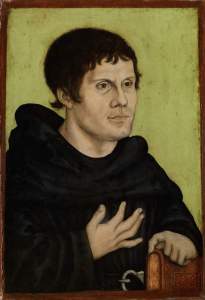
499 years ago today, Martin Luther nailed a copy of his 95 theses for disputation on the door of the Wittenberg Castle church, igniting the Protestant Reformation. According to Lawrence J. Raymond, Jr. in his book Sexual Liberation: The Scandal of Christendom, Luther also ignited a sexual revolution.
The intellectual scaffolding of the late medieval church was the scholasticism of Thomas Aquinas. Sexual pleasure, according to Aquinas, could only rightly accompany the desire to procreate. All other expressions of human sexuality were sinful. Aquinas condemned the “animal-like” nature of sexuality which was “untempered by reason.” He approvingly quoted Augustine: “Nothing so casts down the manly mind from its height as the fondling of a woman.” The sexual was the antithesis of the spiritual.
The Renaissance challenged the medieval worldview. Its humanism rediscovered the human body in all its sensuousness. Lawrence calls the Reformation “the religious dimension of the Renaissance.” Luther was to lead this sexual revolution. Initially he steered clear of sexual matters. The Ninety-Five Theses are silent on the subject of sex, instead attacking the abuses of church authority. Luther’s early dissent ignored the church’s proscriptions regarding sex. Challenging the authority of the pope and the Roman magisterium led to the questioning of the discipline of clerical celibacy. Once the virtue of obedience was undermined, the virtue of chastity inevitably came under scrutiny. For most people, the assault on the sexual values of the medieval church became the most prominent feature of the movement for reform. “[S]ex became the cause célèbre of the Reformation,” Cunningham says.
Luther’s doctrine of sola scriptura undermined the church’s sexual doctrine for want of a biblical basis. Moreover, Luther claimed the church’s rules on sex were humanly impossible to adhere to. Not one in 100,000 could abide by them, he wrote, bluntly saying, “Nature never lets up …we are all driven to the secret sin. To say it crudely but honestly, if it doesn’t go into a woman, it goes into your shirt.” Inspired by Luther, priests, monks and nuns abandoned their monasteries and convents and sought marriage. Luther himself married a former nun, Katharina von Bora, in 1525, a scandalous act. Relations between a priest and nun were considered incentuous. Intercourse with a nun was even a capital crime. Philip Melanchton opposed it. Catholic polemicists attributed his ecclesiastical defiance to his lust. (Luther himself admitted, “I burn with all the desires of the unconquered flesh.”)
Luther cannot be counted as a prophet of modern sexual liberation. He opposed adultery, divorce, prostitution and promiscuity. But he was radical for his times. He supported his benefactor, Philip of Hesse, entering into a bigamous arrangement. He speculated that polygamy, which was sanctioned in the Hebrew Bible, would return. He enthusiastically endorsed the experience of sexual pleasure. A letter to an engaged friend rejoiced that both men will “penetrate” their wives (both coincidentally named Katy). He advised a man whose wife suffered from syphilis to choose bigamy over adultery, a course preferable to chastity. Similarly, a woman with an impotent husband was counseled by Luther to take a man (preferably with her husband’s consent) in order to satisfy her sexual needs. “If the husband is unwilling, there is another who is.”
The rigid and oppressive sexual morality of medieval Catholicism was ripe for rebellion. Sexual freedom led to the proclamation of “evangelical freedom,” Cunningham claims, summed up in Luther’s famous admonition, Pecca fortiter. “Thus it was that many found sexual liberation under the sway of Luther and sixteenth-century Protestantism.”
 Lutheran Guilt
One thought on “Martin Luther: Sexual Reformer?”